The UK’s open-source AI won’t be safe by default
The UK government just made a £60 million bet on open source AI, challenging the current trajectory of frontier development.
Announced by UK Research and Innovation (UKRI) through the Engineering and Physical Sciences Research Council (EPSRC), the funding splits across two parallel academic efforts: BOLD (British Open-ended Learning and Discovery), based in Oxford and led by Jakob Foerster, and SOFAIR (Science of Fundamental AI Research), directed by David Barber across UCL, Edinburgh, Cambridge and Oxford. Each hub received an initial £8 million and will receive additional funding after an assessment in autumn 2026. While BOLD brings together five established labs across Oxford, UCL, and Imperial to rethink neural network optimisation beyond backpropagation, integrate multi-agent coordination directly into training, and advance embodied AI, SOFAIR targets the core computational bottlenecks of frontier AI. With roughly 50 researchers and a six-year runway, SOFAIR aims to move past standard transformer architectures, unlock pre-training across distributed clusters, and lead global open-source efforts.
The technical case for this dual initiative is a direct challenge to the hyperscaling approach that defined the past four years. Pouring billions into massive data centres to train ever-larger transformer-based models is running headfirst into physical, financial and energetic walls. BOLD and SOFAIR look instead to biological intelligence for inspiration: human brains do not need nuclear power plants to make sense of the world, nor do they require vast corpora of static text to build functional models of reality. By developing new architectures and decentralised training paradigms that can leverage the UK and Europe's fragmented data centres, the initiatives hope to prove that frontier capabilities do not require brute-force scaling and supersized infrastructure.
SOFAIR launched last Wednesday with a full day of talks and panels at Kings Place, London. It outlined clear geopolitical ambitions and a palpable urgency around technological sovereignty. For the UK, this is an attempt to position itself as a new player in the US and China dominated race and become independent from their closed APIs and open-weight models. Domestic public services, healthcare, and industry are otherwise vulnerable to foreign export controls, data privacy and copyright issues, and volatile commercial roadmaps.
The initiative also shows a conscious effort to shake off the UK’s chronic defeatism, stop acting as a talent pipeline for US labs, and become a serious contender in the AI industry. There was a strong conviction in the room that if an AI system is trained on collective human knowledge, it already belongs to the public. And treating models as the private intellectual property of a handful of venture-backed monopolies is a violation of public interest.
SOFAIR faces a tough operational reality: the initiative has only secured 2 million GPU hours per year, and is actively seeking donations to get to a minimum of 20 million—ideally 40 millions. While their goal isn’t to race with frontier models on compute, delivering on their mission will still require organisational discipline and a level of confidence and investment that the UK research and venture ecosystems have historically struggled to show.
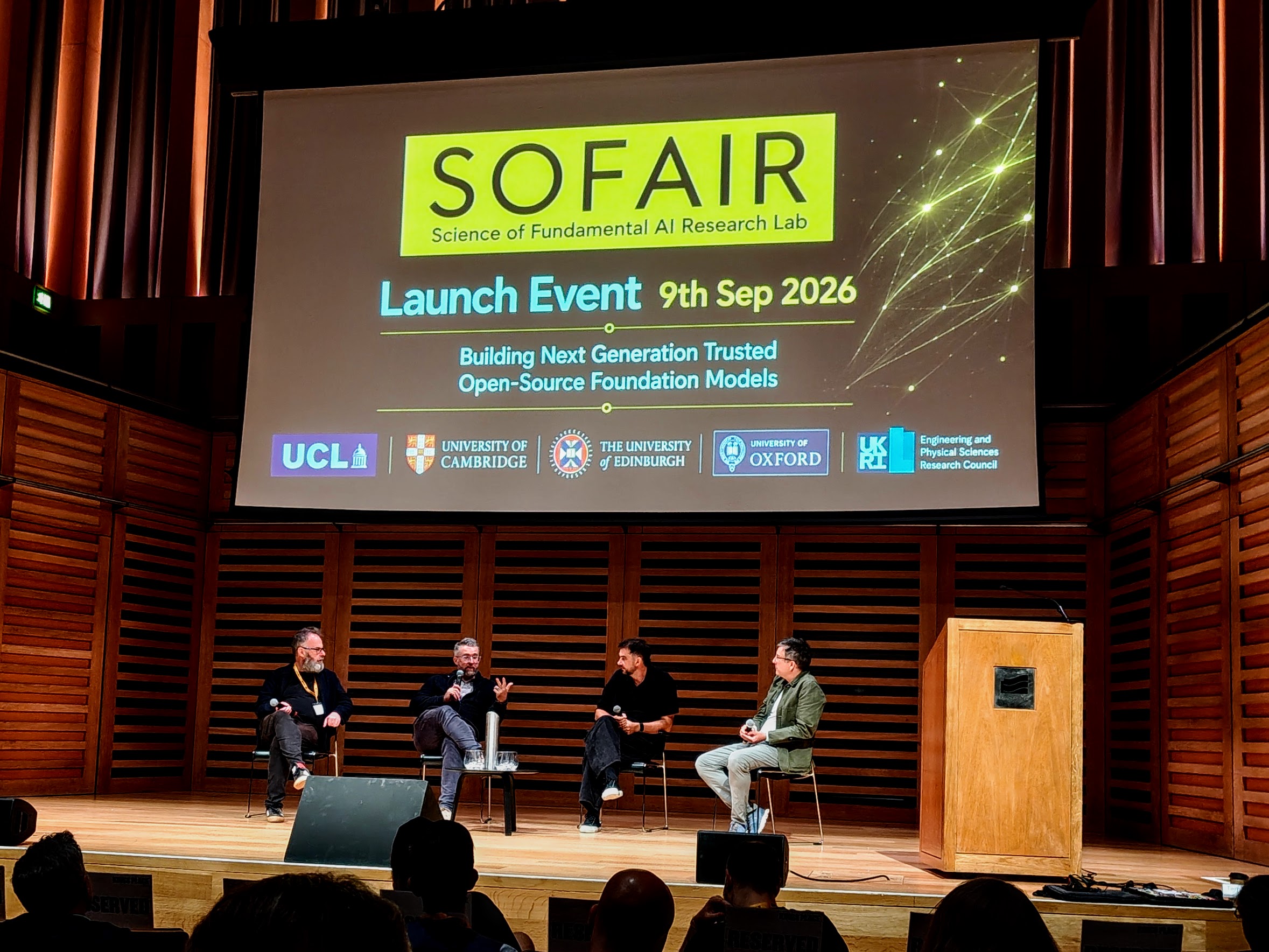
I attended the launch specifically to understand how a publicly funded initiative might approach AI safety differently, how we could learn from the containment and alignment failures seen across the private sector models over the past couple of years.
Safety was never explicitly mentioned.
This omission might point to a belief that safety issues are a consequence of transformer architectures and commercial scaling pressures, rather than intrinsic properties of capable autonomous systems. The assumption seems to be that novel architectures centred around transparency and auditability will make standard safety toolkits (alignment finetuning, evals, runtime control) obsolete by design.
There is also an understandable operational argument here. SOFAIR only has an initial £8 million budget: they can’t address every problem at once. It’s also fair to say that little immediate risk will come from models trained on limited academic compute. This might explain why safety is put on the back burner until the foundational models are off the ground and core capabilities are proven.
As SOFAIR’s mission is to build new architectures from first principles, I thought: will they include safety constraints in their requirements? When I asked this to the leadership panel, the answer missed the point. They see safety as downstream guardrails that are best owned and implemented in context by whoever uses the open models for their specific use case.
Follow-up conversations confirmed a clear gap of understanding between capability research and technical safety. To be fair to the team, SOFAIR is not blindly chasing capability at all costs: they explicitly put transparency and auditability at the front of their research agenda. But when asked about integrating other safety objectives into core architectural design and pre-training objectives, the team acknowledged not knowing enough to answer. When I mentioned evaluations and control, they argued that it is the duty of research to publish raw base models without fine-tuning. Biologists can develop a virus and make it available for research while making sure it is contained and that risk mitigation is in place. Overall, safety beyond transparency and reliability was clearly not on the front of their mind. And underneath their commitment to open research, I also detected a certain anxiety about pace: they admitted that they could not afford to slow down now because the frontier labs would pull ahead.
SOFAIR’s emphasis on transparency and auditability, is an important step towards safer models. But interpretability, assuming it is feasible, does not guarantee alignment, nor does it prevent a model from going rogue. Unless control, monitoring, and safety evaluations are formalised as explicit success criteria for the research from day one, new models will drift towards existing and new failure modes. Realistically, academic labs working with a fraction of the frontier industry’s compute may never produce models that match the capabilities of US flagship models. Competing on raw capability is the wrong race anyway. If the UK cannot beat frontier labs on that front, its true differentiator should be to pioneer architectures that are genuinely safe by design. That means establishing control, evaluation and governance as equally important research tracks rather than offloading risk onto the public or passing the buck to the AI Safety Institute who’s already overburdened by frontier AI risks.
It is early for SOFAIR. With initial assessments this autumn and scope for UKRI to open new funding streams, the consortium still has the opportunity to prove that alignment and control can be engineered into public-interest models from the start.
References
UK Research and Innovation (UKRI). UKRI launches two AI research labs to stay ahead in global race. 23 Jun 2026
Science of Fundamental AI Research (SOFAIR). Building the next generation of AI through fundamental research.
British Open-ended Learning and Discovery (BOLD). Building the next AI paradigm.