The week Washington poked the Sovereign AI hive
Let’s start with a summary what happened:
- On June 9th, Anthropic released Fable 5, safety-guardrailed public version of its Mythos 5 model
- Last Friday afternoon, June 12th, the US government contacted Anthropic with a sudden ultimatum: patch a newly discovered jailbreak vulnerability or go offline within 90 minutes.
- When Anthorpic requested clarifications, the government issued an export control order, barring access to the models for all foreign nationals, on US soil or outside
- Anthropic couldn’t implement the differentiated access for non-US citizens on such short notice, and had to close access to everyone worldwide, triggering immediate shortages for enterprises relying on these models and forcing them to fall back to previous models.
- The order from the US government was apparently triggered by an Amazon report and a direct call from Andrew Jassy about a jailbreaking technique that forces Fable to identify known system vulnerabilities.
- Anthropic defends the capability as a standard tool for cybersecurity professionals, noting competitors like GPT-5 possess identical capacities.
- Unconfirmed reports suggest Washington’s real fear was that Chinese labs had already secured access to the models and were preparing to clone the models via distillation.
- While the negotiations between the US government and Anthropic are still ongoing to get Fable and Mythos back online, the media and pundits are debating the real motivations behind the shutdown. Speculation ranges from a petty, politically motivated hit job stemming from interpersonal friction between Dario Amodei and officials, to the simple result of Anthropic's own lobbying efforts on catastrophic risk and dual-use cyber capabilities.
What we can agree on:
- Whatever motivated the US gov to place the ban, this is not AI governance. There was no transparency regarding risk evaluation, no predictable protocol, and no institutional playbook. It was a pure hot-off-the-plate reaction executed under an arbitrary deadline without justifications.
- This week’s events have made AI Sovereignty a burning hot topic.
What is AI sovereignty?
The term is an emerging concept brandished by many nations and coalitions all around the world, but it hides vastly different operational and strategic goals. Overall it could be seen as a set of principles and mechanisms for a country to get maximum benefits from AI while preserving national self-determination. But in practice, the definition of sovereignty is a deeply political act that reflects a nation’s priorities and vulnerabilities: protecting national security, insulating economic growth from foreign monopolies, enforcing domestic regulation, defending cultural and linguistic norms, etc…
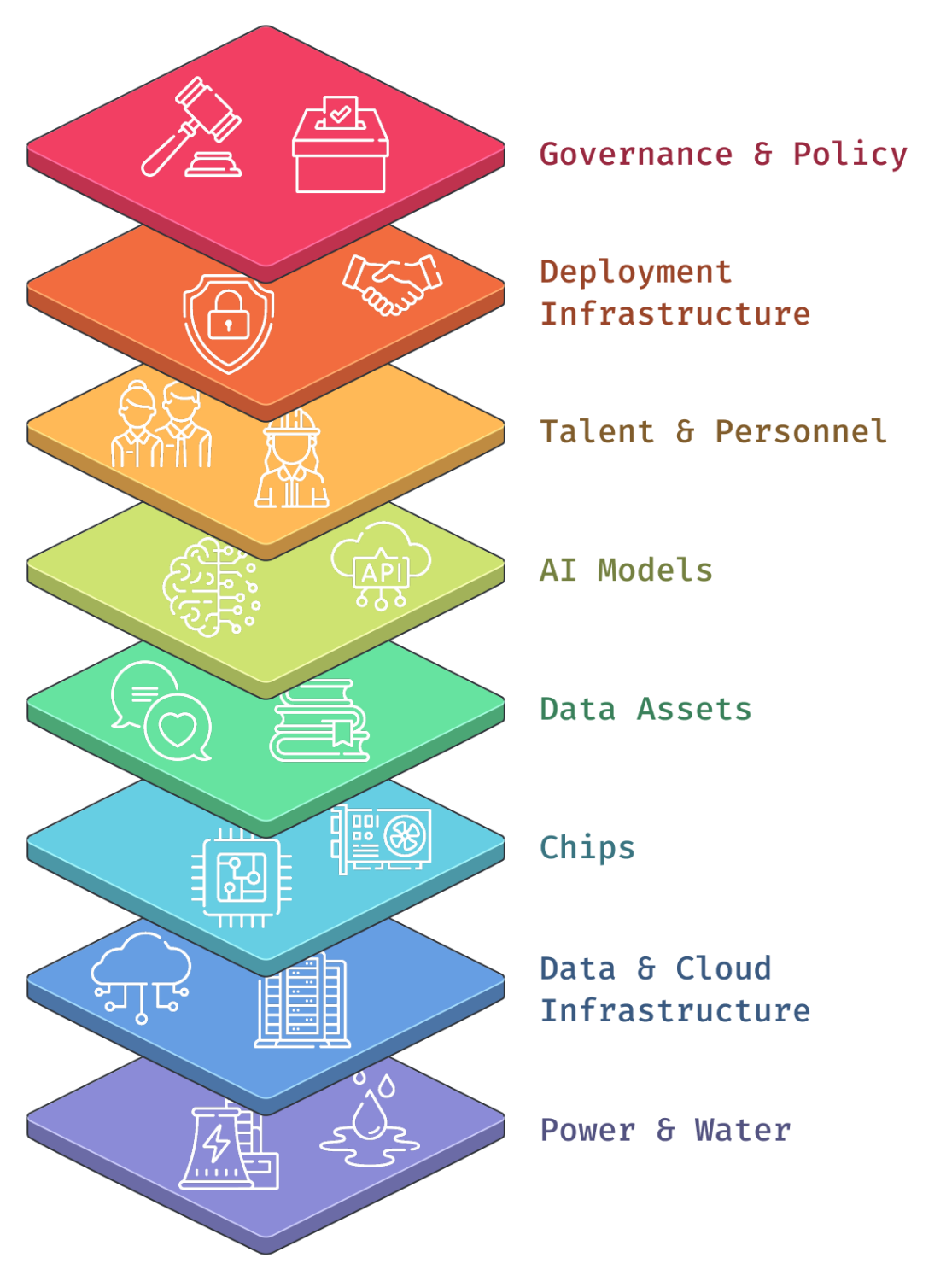
To understand the intricacy of AI sovereignty, we need to consider the interconnected infrastructure stack that supports the creation and usage of AI:
- Power and water: the domestic energy capacity to run massive compute loads sustainably.
- Silicon/chips: access to advanced lithography and graphics processing units (GPUs) required for training and inference
- Data centers and cloud infrastructure: the physical facilities and domestic networks where the models run
- Data assets: the training material, including everything from highly specialised and private datasets (e.g. healthcare, law), localised datasets and indigenous language corpora to the regulatory frameworks governing IP protection and data-harvesting marketplaces
- AI Models: the strategic choice between relying on proprietary, closed-source remote APIs or developing locally hosted inspectable open-weights models
- Talent and personnel: the pipeline of AI engineers, safety researchers and security-cleared personnel required for model development and operations (ModelOps)
- Deployment infrastructure: The sectoral security frameworks, enterprise approval processes, and change-management protocols required to embed AI into industry and public services securely
- Governance and policy: The legal superstructure, including laws, regulation (such as the EU AI Act or regional state mandates), and enforcement processes, that dictates and enforces the boundaries of permissible risk and algorithmic behavior
That’s a lot for any nation to fully control, and absolute independence is a structural myth. Political scientists Robert Keohane and Joseph Nye proposed in their Complex Interdependence Theory (1977) that modern states are bound by inter-dependencies in a deeply connected global system. Applied to technology, as Srivastava & Bullock (2024) note, sovereignty is about managing strategic dependency to achieve “networked autonomy”.
This creates a hard limit for AI sovereignty: the stack is inherently transnational and no one nation can realistically control it all. Not even the US, which is dependent on the Global South for its data labelling and on Taiwan for chip manufacturing.
Even within this structural boundary, the quest for AI sovereignty opens the door to major risks:
-
State-sponsored overreach: In the rush to wrest control from Big Tech, power risks being dangerously concentrated within states. The more technological autonomy a government achieves, the fewer external check-and-balance restraints it faces, freeing it to deploy AI for domestic surveillance, propaganda, and other nefarious authoritarian practices.
-
Sovereignty washing: Hyperscalers and frontier labs are openly leveraging geopolitical anxiety to sell Sovereignty-as-a-Service to nations worldwide. They package the concept as infrastructure partnerships, forward-deployed engineering, and bespoke deployment schemes, like the “OpenAI for countries” initiative. This is purely a bid to establish vendor lock-in in nations’ civic architecture and make true sovereignty impossible.
To avoid an isolationist zero-sum game, AI sovereignty should be approached as a strategic balancing act of autonomy and managed dependencies, one that requires a foundation of transparent domestic governance, international collaboration and structurally redundant resources across the entire stack.
Global approaches to sovereign AI
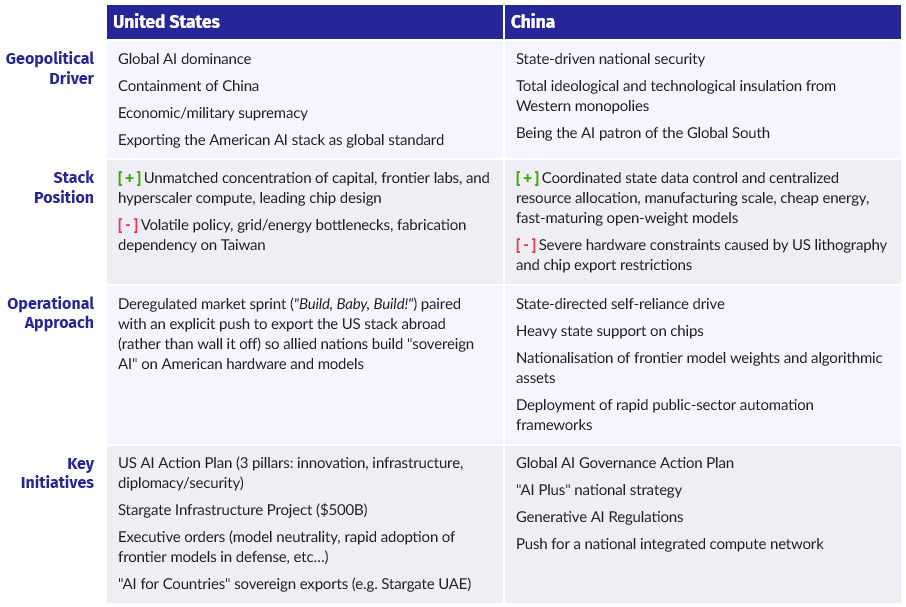
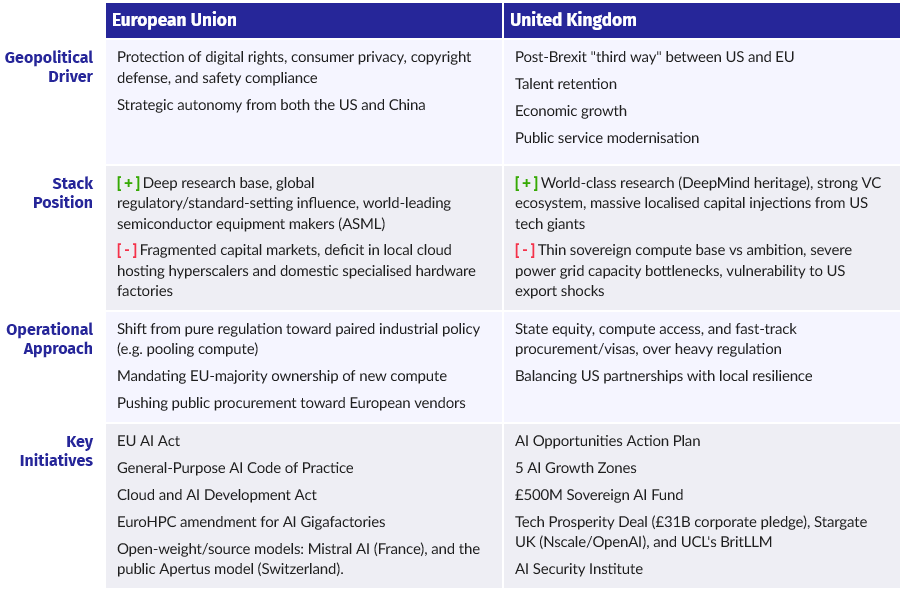
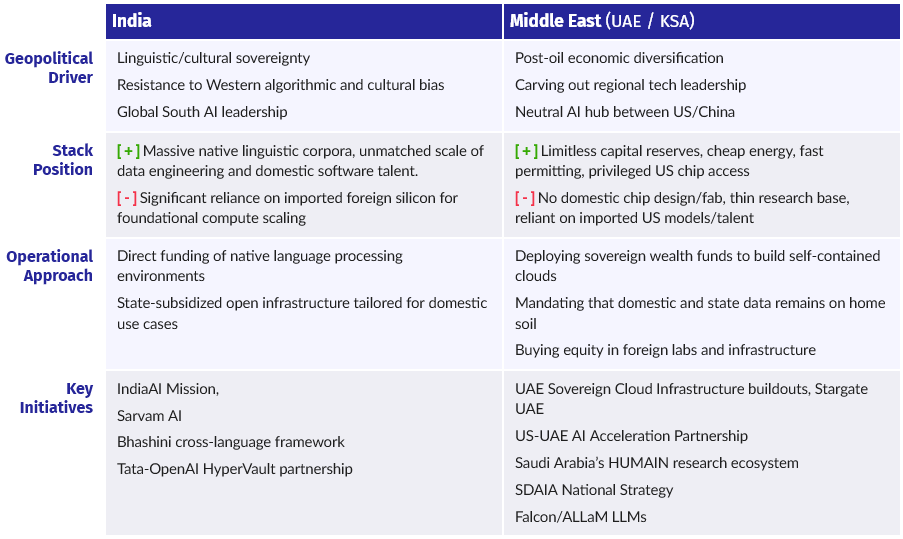
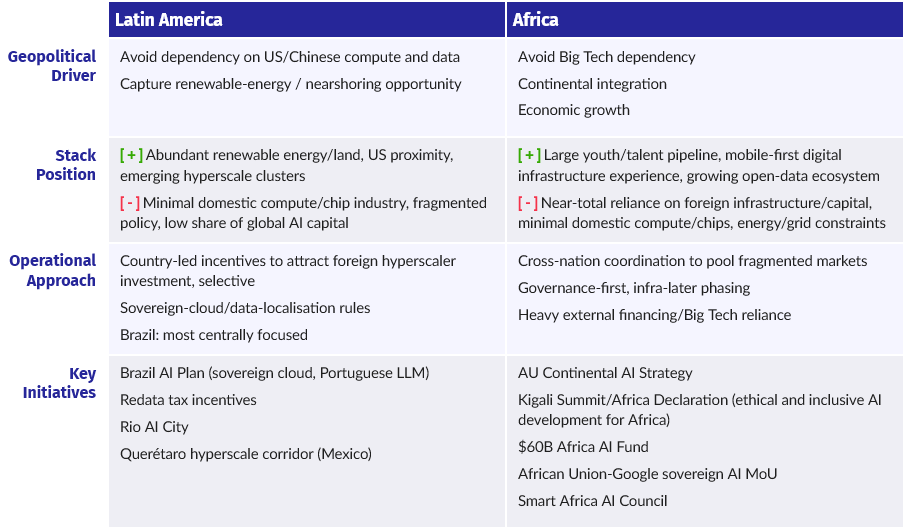
Nations are planning and executing vastly different strategic plays to secure their position in a world with AI. They could be broadly split in three buckets: race for total dominance, defensive regulation, and infrastructure insulation.
An open-weight model's catch-up?
This week’s events exposed the systemic liability of relying on proprietary closed-weight models. Could this crisis serve as a permanent catalyst for the open-weights ecosystem, accelerating the momentum generated by Meta’s Llama and the first DeepSeek releases?
Some nations are already shifting lanes. Switzerland has set a baseline with Apertus, a fully open-source LLM developed specifically as a public utility. Lean architectures prove that frontier capability no longer requires the brute-force scaling that only billionaire US labs can afford. The data backs this up: EpochAI reports that Chinese models have lagged behind their US counterparts by an average of just 7 months since 2023.
Did the US government just poke the rest of the world into catching up? 2026 could be a definitive turning point in the AI geopolitical scene.
References
Srivastava & Bullock, 2024, AI, Global Governance, and Digital Sovereignty, DOI: arXiv:2410.17481
Singh, S.K., Sengupta, S., 2025, Sovereign AI: Rethinking Autonomy in the Age of Global Interdependence, DOI: arXiv:2511.15734
BOSOER, Lucía, INNERARITY, Daniel, Unpacking AI sovereignty, EUI, STG, Policy Paper, 2025/18, Policy Brief - https://hdl.handle.net/1814/94063
Anthropic, Statement on the US government directive to suspend access to Fable 5 and Mythos 5, 12 Jun 2026
Le Monde, 'The AI war has begun': France and Europe worried as US blocks Anthropic's latest AI model, 14 Jun 2026
Reed Albergotti, Semafor, White House’s export limits on Anthropic linked to concerns about Chinese access, 13 Jun 2026
Euronews, 'Wake-up call': Europe reacts to Anthropic halting access to its Fable 5 and Mythos 5 AI models, 13 Jun 2026
Innovation, Science and Economic Development Canada (ISED), Canadian Sovereign AI Compute Strategy, 4 Jun 2026
European Commission, Proposal for the Cloud and AI Development Act (CADA), 3 Jun 2026
European Commission, Communication on European Tech Sovereignty, accompanied by an EU Open Source Strategy, 3 Jun 2026
Liz Kendall, UK Secretary of State for Science, Innovation and Technology, Britain must secure greater control and leverage over AI to protect our national security in fractured world, published on Gov.uk, 28 Apr 2026
Rachel Reeves, Chancellor, and Liz Kendall, UK Secretary of State for Science, Innovation and Technology, AI firms pioneering drug discovery, cheaper supercomputing and more get first backing through UK’s Sovereign AI, published on Gov.uk, 16 Apr 2026
TechCrunch, France to ditch Windows for Linux to reduce reliance on US tech, 10 Apr 2026